
close
Choose Your Site
Global
Social Media
Views: 0 Author: Site Editor Publish Time: 2026-07-23 Origin: Site


Consumer demand has decisively shifted toward the modern Zipper Baby Romper. Parents increasingly prioritize late-night convenience over traditional snap closures. Midnight diaper changes require speed. Wrestling tiny snaps in the dark frustrates tired caregivers. For apparel brands and manufacturers, this shift demands immediate attention. It requires re-evaluating assembly line workflows and material sourcing. Transitioning away from complex closures eliminates severe production bottlenecks. While incorporating two-way zippers introduces specific compliance requirements, it ultimately streamlines the cut-and-sew process. It drastically reduces alignment errors across the factory floor. You will learn how to optimize your supply chain for these popular garments. We explore structural simplicity, component selection, and strict safety regulations. We also detail how to shortlist the most capable manufacturing partners. This comprehensive guide provides actionable insights for creating a highly scalable and successful product line.
Assembly Speed: Zippers replace the need for 10–15 individual snap-setting operations with a single, continuous insertion process.
Labor Efficiency: Continuous seam sewing reduces the specialized machinery (e.g., pneumatic snap presses) and alignment checks required on the factory floor.
Safety Compliance: Manufacturing requires strict adherence to CPSC (or local equivalent) guidelines, specifically regarding zipper pull torque testing and skin-pinch protection.
Unit Economics: The higher raw material cost of a quality two-way zipper is typically offset by reduced labor time and lower defect rates in final Quality Assurance (QA).
Brands must acknowledge end-user realities. Parents actively avoid snaps for night changes. Exhausted caregivers struggle to match buttons in low-light conditions. Manufacturing a zippered garment aligns your product lines directly against proven market demand. You capture a loyal customer base by solving a universal parenting frustration. Utility drives repeat purchases in the infant apparel sector.
Traditional snaps introduce numerous failure risks during production. They require multiple, precise alignment points along the fabric edge. A single misaligned snap ruins garment functionality. If one piece sits slightly off-center, the entire outfit bunches up. Zippers consolidate this complex closure mechanism. They reduce potential points of failure significantly. Quality assurance teams spend less time rejecting misaligned units.
Fabric tearing remains a massive warranty issue for infant wear. Snaps concentrate stress on tiny areas of the garment. Pulling garments apart repeatedly weakens the surrounding textile fibers. This leads to holes and dissatisfied customers. Zippers distribute tension evenly across the garment's front seam. This structural advantage extends the clothing lifecycle.
To fully grasp this industry shift, consider these primary drivers:
Customer Loyalty: Caregivers actively seek brands offering frictionless diaper changes.
Defect Mitigation: Assembly lines eliminate multi-point failure zones inherent to button pressing.
Durability Increases: Even tension distribution prevents fabric tearing around closure points.
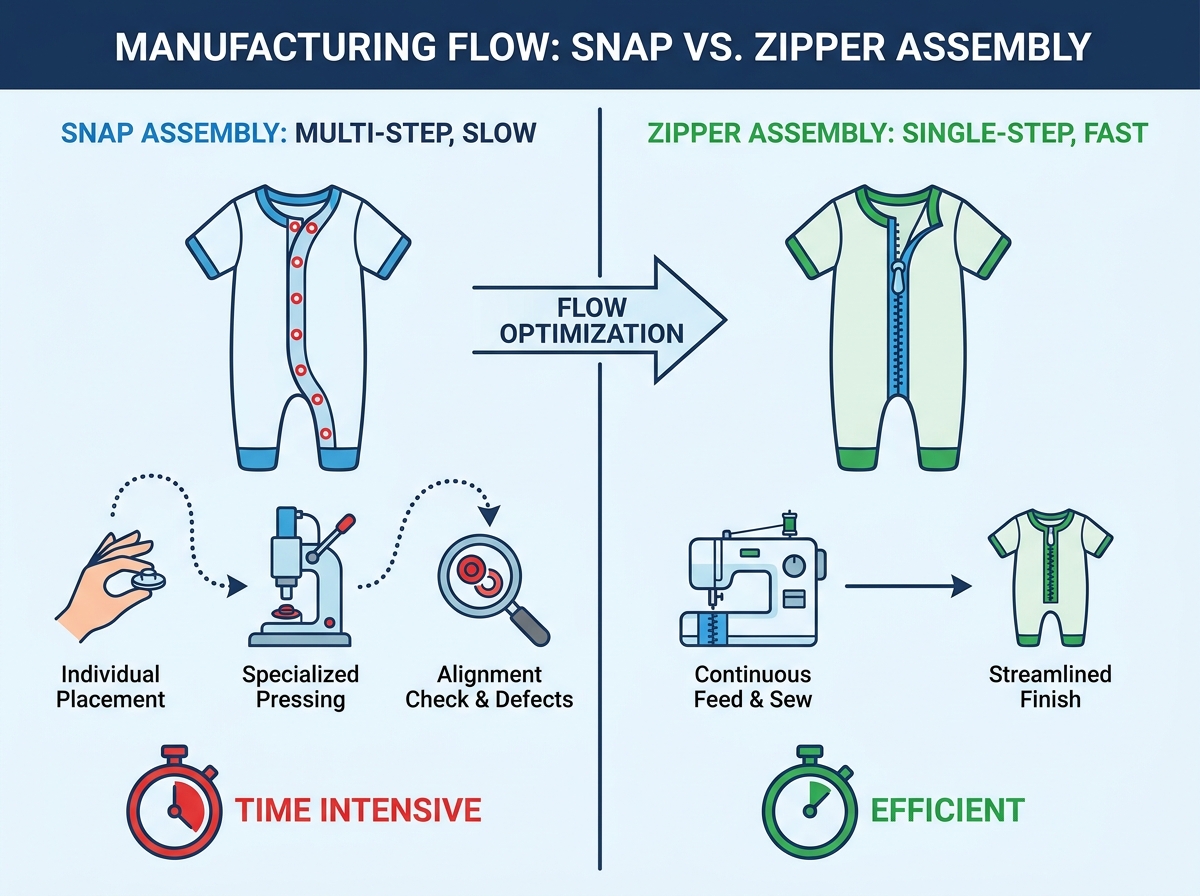
Pattern making becomes remarkably streamlined. Patterns for zippered rompers often require fewer overlapping plackets. Snap closures demand extra fabric layers for reinforcement. Zippers allow for asymmetrical or continuous neck-to-ankle seam designs. Operators feed these continuous edges much faster through commercial sewing machines. Less fabric folding means less handling time per unit.
Machinery requirements change drastically on the factory floor. You eliminate severe routing bottlenecks. Garments no longer pile up at specialized snap-pressing stations. Zipper insertion utilizes standard single-needle lockstitch machines. Factories simply equip these machines using standard zipper feet. This keeps garments moving steadily down a linear assembly line. Workflow becomes predictable and highly efficient.
Maintaining even fabric tension presents the primary manufacturing challenge. Operators must prevent puckering during insertion. High-stretch bamboo or modal fabrics slip easily under the needle. These textiles feel incredibly soft but require advanced handling skills. Walking foot machines often help stabilize stretchy fabrics. Operators must balance feed dog speed against needle penetration. Mastery here separates premium brands from budget alternatives.
Factories employ specific best practices to combat tension issues:
Utilizing specialized walking feet to pull top and bottom fabric layers evenly.
Applying temporary water-soluble basting tape before final stitching.
Adjusting thread tension dials based on the specific GSM (grams per square meter) of the bamboo fabric.
Conducting daily machine calibration checks before operators begin their shifts.
Not all closures belong on infant apparel. Manufacturers must evaluate materials based on flexibility, weight, and safety. Nylon coil serves as the undisputed industry standard for baby garments. It remains highly flexible, lightweight, and exceptionally smooth. It bends easily when infants crawl or roll. Molded plastic offers durability but feels too rigid for tiny bodies. Metal must be strictly avoided. Metal introduces unnecessary weight and severe rigidity. It also risks heavy-metal compliance failures during safety audits.
Table: Zipper Material Comparison
Material Type | Flexibility | Weight | Suitability for Infant Wear |
|---|---|---|---|
Nylon Coil | High | Lightweight | Excellent (Industry Standard) |
Molded Plastic | Medium | Medium | Poor (Too rigid) |
Metal | Low | Heavy | Avoid (Safety/Toxicity Risks) |
Two-way zippers represent a non-negotiable feature for modern designs. They allow crucial bottom-up diaper changes. Parents unzip just the lower half, keeping the infant warm up top. However, supply chain planning requires foresight here. Two-way variants carry higher Minimum Order Quantities (MOQs). Top-tier suppliers like YKK or SBS demand longer lead times. Brands must forecast inventory needs months in advance.
Backing tape selection demands equally rigorous attention. The zipper tape must match the stretch and shrinkage profile of your primary fabric. Bamboo rayon shrinks differently than cotton. If the fabric shrinks but the tape does not, severe waving occurs post-wash. This distortion ruins the garment's visual appeal. Pre-washing tape samples alongside fabric swatches prevents this disaster.
Infant clothing manufacturing demands uncompromising safety standards. Choking hazard mitigation remains the top priority. The zipper pull and slider must pass strict torque and tension tests. Testing facilities apply 15 pounds of force for 10 seconds. Sliders must endure this without detaching. A detached pull becomes an immediate, lethal choking hazard. You must request certified lab results for every hardware batch.
Skin protection requires complex construction techniques. You cannot simply sew a raw zipper into a baby garment. A continuous inner fabric guard is mandatory. This soft flap rests between the plastic coil and the infant's skin. A top "zipper garage" provides additional safety. This fold-over fabric piece sits securely at the neckline. It houses the metal pull when fully zipped. It prevents the slider from scratching the baby’s delicate chin or neck.
Implementing these protective features adds precise sewing steps. Creating a clean, bulk-free zipper garage requires highly skilled operators. Bulky folds irritate the infant. Seamstresses must trim seam allowances carefully. The inner flap must lie perfectly flat after washing. These steps distinguish premium manufacturing from careless assembly.
Chemical compliance dictates hardware finishing. All painted sliders and pulls must undergo lead testing. Regulatory bodies require items to be certified lead-free and phthalate-free. You must maintain documented chain-of-custody forms from the manufacturer. Failing a chemical audit results in devastating product recalls. Always specify non-toxic, baby-safe paints in your technical documents.
Evaluating factory expertise determines your product's ultimate success. Never assume a general apparel factory understands infant safety nuances. Request prototypes specifically constructed from your exact target fabric. Ask them to use your chosen 95% Bamboo and 5% Spandex blend. Inspect these samples rigorously for seam puckering. Stretchy knits reveal poor sewing skills instantly. An experienced partner will deliver a perfectly flat front seam.
Examine their compliance infrastructure thoroughly. Ask for their standard operating procedures (SOPs) regarding torque testing. Do they test internally, or do they hire third-party labs? Reliable factories own specialized pull-testing equipment on-site. They randomly sample products directly from the daily assembly line. Request video proof of their testing methodology. Transparency here indicates a trustworthy supply chain partner.
Avoid rushing straight into bulk production. Commission a comprehensive tech pack first. This document serves as your manufacturing blueprint. It must clearly detail specific zipper garage dimensions. Specify the exact inner flap width down to the millimeter. Call out your exact nylon coil specifications, including Pantone color matches. Clear instructions prevent expensive misunderstandings.
Order initial size runs before authorizing large volumes. Test these garments through multiple high-heat wash cycles. Observe how the continuous seam behaves after laundering. Only proceed to full-scale manufacturing once the prototype survives intense physical testing.
Transitioning to a Zipper Baby Romper transforms your manufacturing efficiency. It replaces a labor-intensive, multi-point closure system with a streamlined, continuous seam. This shift aligns perfectly with modern consumer demands for convenience. While raw materials and safety compliance require strict oversight, the benefits remain undeniable. You significantly reduce assembly line bottlenecks and alignment defects. This approach builds a highly scalable, reliable product line. Consult your sourcing agent today. Review two-way hardware lead times and request a sample run to test tension compatibility on your chosen textiles.
A: Snaps are cheaper in raw material costs, but zippers often result in lower overall manufacturing costs at scale. This happens due to reduced labor time and lower defect rates in alignment. Assembly lines move faster when sewing a continuous seam instead of pressing individual buttons.
A: A flexible, two-way nylon coil zipper is the industry standard. It feels soft against the body, lacks sharp edges, and flexes naturally alongside the baby's movements. You should completely avoid heavy metal or rigid molded plastic options.
A: Yes. Custom-dyed zipper tape and plastic sliders typically add two to four weeks to your supply chain lead time. Pantone-matching requires specialized batch processing compared to ordering standard stock colors.
A: A zipper garage is a small fold of fabric sewn directly at the collarline. It securely houses the pull when fully zipped. This feature prevents the hard metal or plastic slider from scratching the baby’s neck or chin.


