
close
Choose Your Site
Global
Social Media
Views: 0 Author: Site Editor Publish Time: 2026-07-01 Origin: Site


Sourcing a Baby Romper for a wholesale or retail collection requires balancing strict safety compliance. You must juggle unit economics alongside parent-driven design preferences. Retail buyers often underestimate this complex intersection. Making the wrong choices early on damages your brand reputation permanently.
For boutique owners and brand managers, poorly vetted product lines pose severe operational risks. They lead directly to high return rates. Unsold dead stock crowds your valuable warehouse shelves quickly. You might even face devastating regulatory fines. Getting this foundational step right matters immensely for your long-term bottom line.
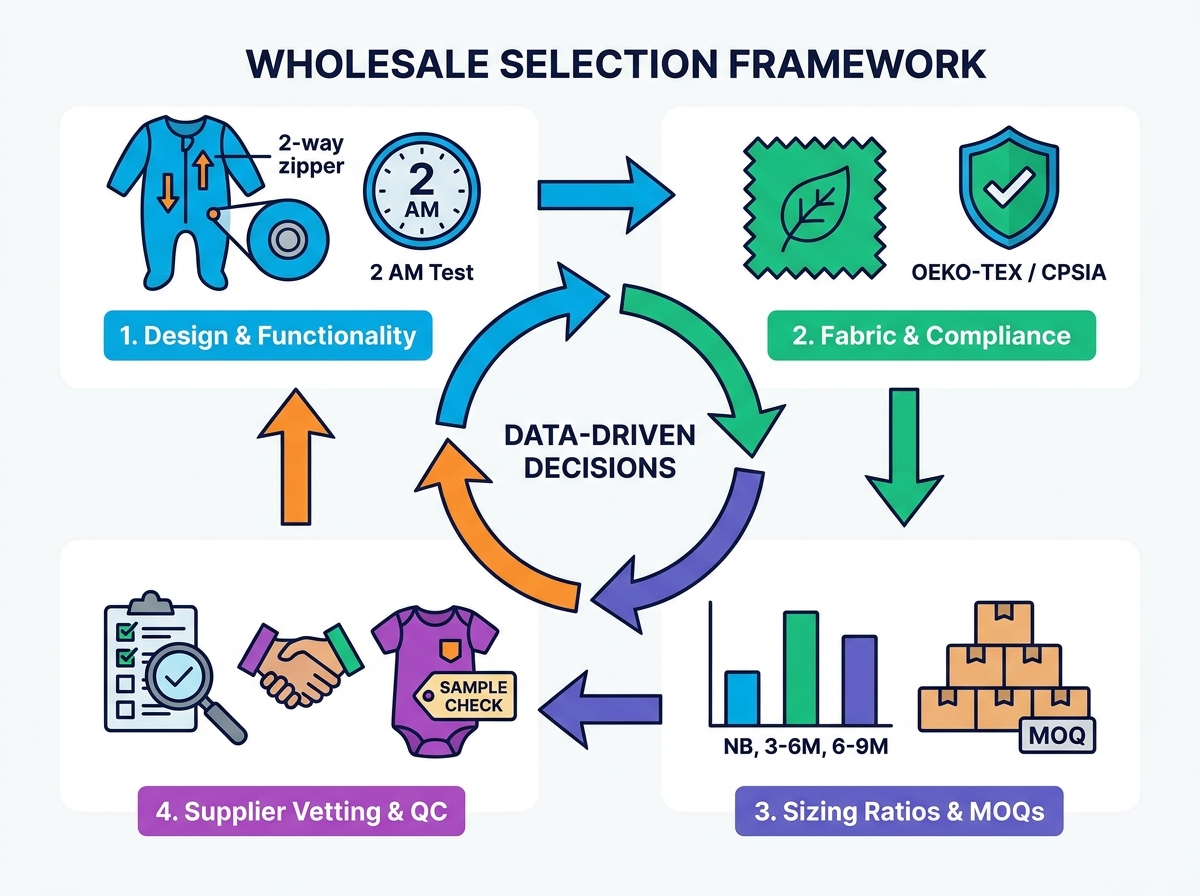
This guide provides a systematic framework for your purchasing journey. We evaluate wholesale infant apparel comprehensively. You will learn to assess manufacturer reliability effectively. Finally, we help you finalize bulk purchase decisions confidently. Follow these steps to build a profitable, compliant infant clothing line.
Design for Functionality: Fastening mechanisms (two-way zippers vs. snaps) and neck expansions directly dictate consumer sell-through rates.
Compliance is the Baseline: Fabric selection must pass rigorous safety certifications (e.g., CPSIA, OEKO-TEX) before considering aesthetic value.
Strategic Sizing Ratios: Wholesale orders require weighted size distributions rather than even splits, avoiding dead stock in niche age brackets.
Vetted Sourcing: Assessing a supplier’s Minimum Order Quantity (MOQ) flexibility and sampling process is critical for risk mitigation.
First, clarify the precise product definition for your catalog. You must position your garments correctly in the market. Rompers typically feature legless or short-legged silhouettes. They serve completely different seasonal needs than full-length one-pieces. A classic Baby Romper dominates spring and summer collections. It allows infants to stay cool during active daytime play. Conversely, one-pieces dominate colder climates and sleepwear categories. Understanding this distinction prevents massive seasonal inventory mismatches.
Garment fastenings must pass practical utility evaluations. Parents prioritize convenience above all aesthetic details. We call this the "2 AM diaper change" test. Imagine a sleep-deprived parent changing a diaper in total darkness. How easily can they manage your garment?
Two-way zippers: These offer ultimate convenience. They cost slightly more to manufacture. Yet, they drive massive retail appeal and customer loyalty.
Magnetic closures: These represent a luxury premium tier. They speed up changes dramatically. You must strictly ensure pacemaker safety warnings on packaging.
Traditional gusset snaps: These keep factory production costs low. Unfortunately, they frustrate tired parents easily. Misaligning tiny snaps causes frequent negative reviews.
Assess neckline construction carefully during the design phase. Envelope necklines allow incredibly easy overhead dressing. You can also pull them down over the shoulders safely. This helps immensely during messy diaper blowouts. Shoulder snaps provide another excellent structural alternative. They offer a cleaner modern aesthetic while maintaining wide openings. Ease of dressing remains a primary driver of positive customer reviews. Happy parents always become profitable repeat buyers.
Best Practice: Always test prototype samples on real infants. Evaluate ease of movement and hardware durability.
Common Mistake: Never sacrifice fabric stretch just to use a stiff, trendy material.
Fabric choice dictates your entire brand reputation. We must compare several popular market options. Standard cotton offers highly reliable durability. It handles high-temperature consumer washing extremely well. Bamboo viscose currently leads the premium infant market. It feels incredibly soft against sensitive skin. However, bamboo tends to shrink more noticeably during laundering. Organic cotton blends combine rugged durability and eco-friendly marketing appeal. They provide excellent breathability for active crawling infants.
You must map out required certifications for your target market. Treat regulatory compliance as absolute non-negotiables. Never bypass these strict legal requirements. In the US, you need documented proof of CPSIA compliance. European markets demand strict REACH adherence. OEKO-TEX Standard 100 certification provides global consumer peace of mind. It ensures your products remain entirely free from harmful substances. Insist on verifying these documents yourself. Check third-party lab results directly. This diligence mitigates massive legal and reputational risks.
Evaluate the chemical safety of all used dyes. Reactive dyes bond deeply into raw fabric fibers. They offer excellent, long-lasting colorfastness. Water-based prints provide a much softer hand feel. They also reduce harsh chemical exposure risks significantly. Check colorfastness testing standards rigorously. Bleeding colors during consumer laundering destroy brand trust instantly. No parent wants their laundry load ruined.
Material Type | Breathability | Durability | Shrinkage Risk | Market Positioning |
|---|---|---|---|---|
Standard Cotton | High | Excellent | Low | Value/Everyday |
Bamboo Viscose | Excellent | Moderate | High | Premium/Boutique |
Organic Blends | High | High | Low to Mod | Eco-Conscious |
Ordering equal quantities of every size destroys your profitability. It represents a deeply flawed purchasing strategy. Infants grow at wildly varying rates across different months. Newborn sizes usually fit for mere weeks. Conversely, the 6-9 month bracket sees prolonged, heavy wear. You need a baseline ratio framework.
Follow these weighted sizing steps for better inventory flow:
Limit Newborn (NB) sizes to roughly 10% of total inventory. Parents receive these as gifts very frequently.
Increase 3-6M sizing to roughly 25%. Babies start growing into these outfits quickly.
Maximize 6-9M and 9-12M sizes at 30% each. These brackets see the most active daily use.
Taper off 12-18M sizes to 5%. Toddlers transition into two-piece separates around this age.
This approach prevents dead stock accumulating in niche age brackets.
Suppliers enforce MOQs to guarantee their own factory profitability. You must evaluate how these minimums align. Check your available cash flow and physical storage capacity. Offshore manufacturing often demands extremely high MOQs. You might need to order 1,000 units per color. This locks up crucial operating capital. Lower-MOQ domestic sourcing reduces your overall financial exposure. You pay higher per-unit prices but gain immense agility. Near-shore wholesale sourcing strikes a very solid middle ground.
Calculate your production timeline backward from your launch date. Factor in raw fabric sourcing first. Production itself often takes 30 to 60 days. Ocean freight adds another full month easily. Air freight saves time but crushes your profit margins. Always build generous buffer times for customs clearance. Port delays happen frequently during peak holiday shipping seasons.
Never bypass the crucial prototyping stage. Prototyping saves you from disastrous, unsellable production runs. You must inspect a sample meticulously. Look closely at the exact stitching density. Higher stitch density indicates much stronger seams. Check interior seam flatness carefully. Bulky internal seams irritate delicate infant skin. Ensure hardware security above all else. Tug firmly on every single snap and zipper. Check dimensional stability after rigorous home washing. The garment should retain its shape completely.
Assess your supplier’s internal testing protocols. Do they conduct inline inspections? Inline checks catch sewing errors during active production. Strictly relying on final audits wastes valuable time. Final audits only find mistakes after complete assembly. We highly recommend third-party QC partnerships. Overseas manufacturing requires strict external oversight. Hire reputable agencies to inspect goods before final shipment.
Evaluate the track record of your potential supplier. Communication clarity matters every single business day. Do they answer technical questions accurately? Assess their willingness to share operational details. They should disclose raw material origins willingly. Shady suppliers dodge questions regarding their fabric sourcing. Transparent partners build long-term, profitable mutual trust.
Best Practice: Demand production references from other established Western brands.
Common Mistake: Paying full invoices before reviewing a physical pre-production sample.
You must calculate true expenses accurately. Do not just look at the raw factory price. Break down the entire supply chain cost structure. Your landed cost includes the base unit price. It also involves all inland and ocean freight charges. Add import tariffs to your pricing spreadsheet. Factor in your custom retail packaging materials. Finally, include third-party warehousing fees. Comparing this final landed cost against your target retail price reveals true viability. Healthy margins keep your apparel business alive.
Fashion trends shift rapidly. Overcommitting to hyper-trendy prints creates massive financial danger. You might love a viral seasonal pattern today. It could become entirely unsellable next month. Balance your product catalog intelligently. Prioritize evergreen solid colors. Stock neutral patterns heavily. These basic designs sell reliably year-round. They protect your capital from sudden, unpredictable trend shifts.
Establish a weighted scorecard for final vendor selection. Balance several critical business factors. Look at unit cost and compliance certainty together. Evaluate quoted lead times realistically. Score their daily communication quality. Do not blindly choose the cheapest available factory.
Take your next action step confidently. Request a technical tech pack submission. Alternatively, ask for an initial sample run. Start building the manufacturing relationship slowly.
Choosing the right baby apparel for a B2B collection requires rigorous evaluation. You must analyze functional design elements thoroughly. Strict safety compliance protects your brand and innocent end-users. Strategic inventory planning prevents catastrophic cash flow bottlenecks.
We highly recommend prioritizing transparent, communicative partners. Work alongside suppliers offering incredibly clear sampling processes. Insist on verifiable safety documentation every single time. Avoid factories simply offering the lowest possible unit cost. Low costs usually hide terrible production shortcuts.
Initiate your comprehensive vetting process today. Request a sample kit from your shortlisted manufacturers. Submit your detailed tech pack to gauge their technical capabilities. Take action now to build a highly profitable, unconditionally safe apparel line.
A: Bamboo viscose is currently leading for softness and premium pricing, while 100% organic cotton remains the standard for durability and hypoallergenic claims.
A: Base this on your supplier's MOQ and your customer acquisition cost. A conservative test launch typically targets 100-300 units per style/colorway, spread across 4-5 sizes based on market demand data.
A: A romper is traditionally an unstructured, often short-sleeved/short-legged daytime garment. A sleep-n-play (or footie) provides full-body coverage, commonly used for sleep or colder climates, altering the fabric weight and safety requirements (like snug-fit fire regulations).
A: Request the actual testing reports from recognized third-party labs (like SGS or Intertek) and verify the certificate numbers directly on the issuing agency's database. Never accept self-certified claims.


