
close
Choose Your Site
Global
Social Media
Views: 0 Author: Site Editor Publish Time: 2026-07-31 Origin: Site


For infant apparel brands, the choice between snaps and zippers is no longer a debate. Consumer demand heavily favors zippers for sheer ease of use. Parents rely on quick, seamless nighttime changes. A bulky snap closure slows them down. Poorly specified hardware, however, often leads to high return rates, safety recalls, and negative online reviews. A faulty closure easily transforms a minor inconvenience into a lost customer.
Designing a highly rated Zipper Baby Romper requires precise communication with your manufacturing partners. You must align on hardware types, safety compliance, and fabric compatibility before starting mass production. Misaligned hardware damages both the user experience and your brand reputation.
This guide outlines the exact evaluation criteria, technical specifications, and compliance standards you need. We will detail what to include in your tech packs when sourcing and manufacturing infant sleepwear. You will learn how to mitigate common production risks and confidently elevate your garment quality.
Prioritize 2-Way Functionality: Dual-slider zippers are the baseline standard for addressing the "nighttime diaper change" consumer pain point.
Mandate Nylon Coil or POM Plastic: Avoid metal teeth entirely; specify #3 nylon coil for flexibility or molded plastic for durability.
Enforce Strict Compliance: All zipper components (tape, teeth, pullers) must be explicitly tested for CPSIA (lead/phthalates) and OEKO-TEX Standard 100 Class 1 (baby) compliance.
Design for Skin Protection: Tech packs must mandate top zipper garages (chin guards) and full-length interior fabric plackets to prevent skin pinching.
Anticipate Manufacturing Variances: Require pre-production shrinkage testing to prevent the "wavy zipper" defect caused by mismatched fabric and zipper tape shrinkage rates.
Parents dictate infant apparel trends through vocal feedback across forums and review platforms. Their primary frustration centers on frequent night changes. Traditional snaps create unnecessary friction in low-light conditions. Trying to align tiny metal snaps on a squirming infant exhausts tired parents. Standard one-way zippers also present a flaw. They force caregivers to unzip the garment fully. This exposes the baby’s chest to cold air.
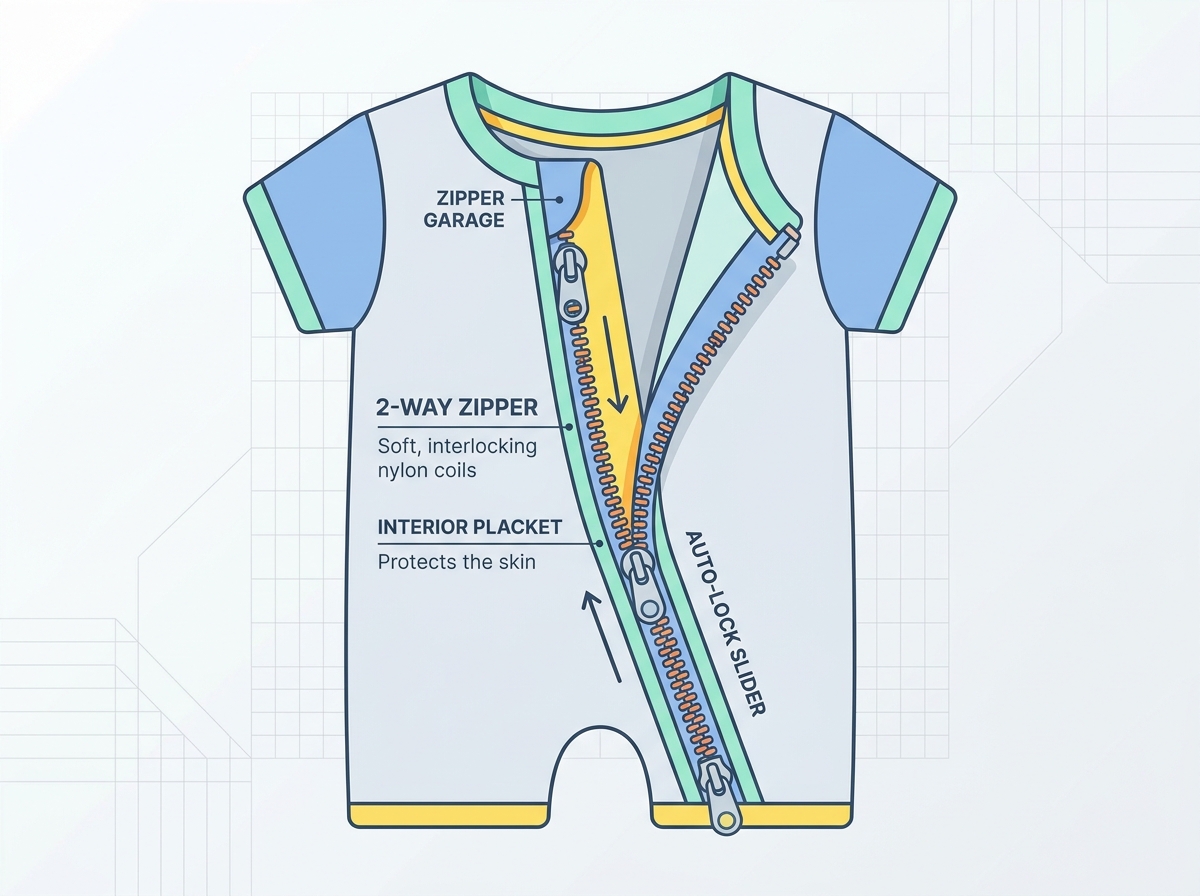
The two-way zipper solves this exact problem. It features dual sliders on a single track. Parents can open the garment from the bottom up to change a diaper. The chest remains securely covered and warm. This functionality is no longer a luxury feature. Consumers view it as a baseline expectation. Brands failing to include two-way zippers quickly lose market share to competitors.
You can further differentiate your product through premium hardware details. Specify silent sliders to avoid waking sleeping infants. Design custom, ergonomic pullers. These small upgrades elevate the perceived value of your Zipper Baby Romper. They turn first-time buyers into loyal brand advocates.
Upgrading from snaps or basic one-way tracks does increase your Bill of Materials (BOM) cost. However, this initial investment protects your profit margins over time. Quality hardware historically reduces return rates. Customers rarely complain about "hardware failure" or "hard to use" designs when you specify the right components. The reduction in customer service tickets easily offsets the higher BOM.
A vague tech pack guarantees production errors. Factory technicians need exact parameters. You must clearly define the zipper size, material, and slider functionality. Ambiguity leads to bulky hardware or weak closures. Infant apparel demands a delicate balance between track strength and lightweight flexibility.
Always specify a #3 size zipper for infant rompers. The #3 gauge provides the optimal balance. It offers sufficient track strength to withstand repeated pulling. Simultaneously, it remains lightweight enough to move fluidly with the garment. Larger sizes like #5 feel too stiff. They dig into the baby's stomach during tummy time.
Material selection strictly limits your options. You must select either Nylon Coil or Molded Plastic (POM). Nylon coil stays exceptionally soft. It bends easily alongside stretchy fabrics like bamboo viscose. Molded plastic offers superior durability and a smoother glide. Both materials perform well in infant wear.
You must explicitly forbid metal zippers. Metal features high thermal conductivity. It feels shockingly cold against a baby's bare skin. Metal teeth also introduce sharp edges. Scratches occur easily during rushed diaper changes.
Hardware mechanics matter just as much as material. You must specify "auto-lock" sliders. Auto-lock mechanisms feature a tiny internal pin. This pin locks into the zipper teeth when the puller rests flat. It prevents the romper from bursting open under tension. Without an auto-lock, an active baby will naturally push the zipper down simply by crawling.
Puller design requires careful oversight. Mandate smooth, rounded pullers. Forbid sharp angles entirely. Reject open rings or complex cutouts. Tiny fingers easily catch inside open hardware gaps. Keep the silhouette simple and safe.
Finally, address the tape material. The zipper tape must complement the romper body fabric. Specify a polyester or cotton-blend tape. The tape weight must match the stretch and density of your garment. Mismatched weights cause structural puckering.
Material Type | Flexibility | Durability | Safety Profile for Infants |
|---|---|---|---|
Nylon Coil (#3) | High (Bends with fabric) | Moderate to High | Excellent. Soft teeth, no sharp edges. |
Molded Plastic (POM) | Moderate | High (Smooth glide) | Excellent. Lightweight, temperature neutral. |
Metal Tracks | Low (Stiff, rigid) | Very High | Poor. Cold to touch, sharp edges. Avoid entirely. |
Infant apparel manufacturing operates under strict global regulations. You cannot rely on a supplier's verbal promise regarding safety. You must mandate recognized certifications. Your tech pack should explicitly demand proof of compliance before you approve any Zipper Baby Romper samples.
Chemical compliance forms your first line of defense. Hardware components undergo surface coating processes. Dyes and paints sometimes contain hazardous chemicals. All hardware must pass Consumer Product Safety Improvement Act (CPSIA) standards in the United States. CPSIA enforces strict limits on lead and phthalates in both surface coatings and substrate materials.
Furthermore, you should require OEKO-TEX Standard 100 certification. Specifically, demand Class 1 certification. Class 1 applies directly to baby articles intended for continuous skin contact. It verifies the absence of harmful substances across every single zipper component. This includes the tape, teeth, sliders, and dyed yarn.
Physical safety presents a different set of challenges. Choking hazards rank as the highest liability in infant wear. You must enforce strict mechanical testing protocols. Product developers should include the following physical safety directives:
Puller Pull-Off Strength: Specify a minimum tensile strength for the zipper pull. Industry benchmarks typically require 15 to 20 lbs of pull-off resistance. The puller must never detach under extreme force. A detached puller instantly becomes a fatal choking hazard.
The Zipper Garage: Tech packs must illustrate a top "zipper garage." This is a folded fabric cover located at the garment's neckline. It houses the top slider securely when the garment is fully zipped. The garage protects the infant's delicate chin from metal friction and accidental pinching.
Interior Placket Shield: A full-length fabric guard must run directly beneath the zipper track. This placket separates the hardware from the skin. It prevents the baby's skin or underlying garments from snagging in the teeth during rapid zipping.
Demonstrating authority in your niche means publishing transparent safety protocols. When customers see your commitment to CPSIA and OEKO-TEX standards, brand trust skyrockets. Safety-first design acts as a powerful marketing tool.
Even perfectly specified hardware fails if installation goes wrong. Garment manufacturing involves manual sewing lines. Human error and material science clash frequently. You must anticipate these implementation risks long before cutting the bulk fabric.
The "Wavy Zipper" defect ruins countless production runs. This puckering effect visually destroys the garment. It occurs due to differential shrinkage. Popular premium fabrics like bamboo, viscose, and ribbed cottons shrink significantly during their first wash. Conversely, polyester zipper tape does not shrink at all. When the surrounding fabric tightens, the static zipper tape buckles and waves.
You can prevent the wavy zipper defect through strict pre-production protocols. Specify preshrunk fabrics in your tech pack. Alternatively, require the manufacturer to wash-test multiple samples prior to mass production. This allows the factory pattern makers to calibrate precise shrinkage allowances. They can ease the zipper tape into the seam to accommodate future fabric contraction.
Seam allowance directly impacts daily usability. Evaluate the factory's stitching precision closely during the sampling phase. The zipper must sit far enough away from the fabric edge. If the stitching runs too close to the teeth, the slider will inevitably catch the track fabric. Parents often zip rompers one-handed in the dark. A snagged zipper ruins the product experience. Mandate a precise seam distance, typically around 0.5 cm clearance from the teeth.
Lead times and sourcing logistics require careful timeline management. Many brands prefer custom-dyed zippers to seamlessly match pantone fabric colors. Dyeing custom tape and molded teeth adds three to four weeks to production lead times. You must account for this delay in your critical path schedule. Delays in hardware delivery stall the entire sewing line.
Mandate a 100% manual zip-test on the finishing line before bagging.
Measure the interior placket width; it should be wide enough (usually 1.5 to 2 cm) to lie flat beneath the track.
Verify the alignment of horizontal stripes or patterns across the closed zipper track.
Check the bottom stop reinforcement. It must withstand aggressive upward pulling.
Your choice of hardware supplier heavily influences your final product quality. Zipper suppliers generally fall into two broad categories. You can choose established global manufacturers or source from open-market local factories. Each path carries specific financial and operational implications.
Tier 1 suppliers dominate the premium market. Companies like YKK, Ideal, and SBS represent the industry gold standard. These enterprise-level manufacturers offer guaranteed compliance. They provide immediate access to valid CPSIA and OEKO-TEX certificates. Their automated quality control ensures consistent sizing and smooth glides across millions of units. Enterprise retailers trust them implicitly.
However, Tier 1 suppliers impose strict constraints. They demand higher Minimum Order Quantities (MOQs). Their per-unit BOM cost sits notably higher than generic alternatives. Custom dye runs with Tier 1 suppliers require significant volume commitments.
Open-market or local factory sourcing presents an alternative for smaller runs. These regional suppliers offer cheaper unit costs. They provide faster availability for low MOQs. Startups often gravitate toward them to save money on initial collections.
Sourcing from the open market introduces severe risks. You face a high probability of encountering counterfeit compliance certificates. Batch quality remains highly inconsistent. One batch might zip perfectly, while the next features sticky sliders and brittle teeth. Tracing the origin of chemical dyes becomes nearly impossible.
We recommend a strict decision matrix for infant apparel. Building a reliable Zipper Baby Romper requires zero compromises on safety. The legal and financial liability of a broken zipper or toxic dye vastly outweighs the fractional savings gained from open-market sourcing. You should exclusively mandate reputable, fully traceable zipper manufacturers in your vendor agreements.
Criteria | Tier 1 Suppliers (YKK, SBS) | Open-Market Suppliers |
|---|---|---|
Quality Consistency | Exceptional across all batches | Highly variable; prone to sticky sliders |
Safety Certification | Verified OEKO-TEX & CPSIA | High risk of counterfeit documentation |
MOQ Requirements | High (often 5,000+ units for custom colors) | Low (accessible for small boutique brands) |
Cost per Unit | Premium pricing | Low pricing |
Specifying hardware for infant apparel functions essentially as an exercise in risk mitigation. A successful garment depends entirely on reliable, rigorously tested components. You must prioritize two-way functionality to meet consumer demand. Strict chemical compliance and thoughtful skin-protection features safeguard both the infant and your brand reputation. Never leave hardware details open to factory interpretation.
Your product developers need to audit all current tech packs immediately. Ensure they explicitly define zipper size, base material, auto-lock mechanics, pull-strength thresholds, and fabric guards. Review your vendor agreements to guarantee Tier 1 supplier usage. Take these critical steps before issuing your next purchase order to secure consistent, high-quality production runs.
A: A two-way zipper features a track with dual sliders. It allows the garment to be opened from the top down or the bottom up. This design is crucial for infant wear. It allows parents to change diapers efficiently without exposing the baby's chest to cold air during the night.
A: This puckering defect is typically caused by differential shrinkage. After washing, the natural or semi-synthetic garment fabric (like cotton or bamboo) shrinks. However, the synthetic polyester zipper tape remains its original length. The mismatched lengths cause the track to buckle. You must wash-test samples to calibrate shrinkage allowances.
A: Both materials work exceptionally well. Nylon coil (#3 size) is often preferred for sleepwear because it is highly flexible, soft, and moves with the baby. Molded plastic (POM) provides superior durability and a very smooth glide. You should always avoid metal zippers due to sharp edges and cold temperatures.


