
close
Choose Your Site
Global
Social Media
Views: 0 Author: Site Editor Publish Time: 2026-07-08 Origin: Site


Ordering a custom Baby Romper goes beyond picking colors and uploading logos. The modern infant apparel market demands exceptional attention to detail. Parents expect absolute perfection when buying clothes for their newborns. For boutique owners and apparel merchandisers, infant clothing carries unique operational risks. Poor hardware selection or incorrect fabric stretch often leads to high return rates. Furthermore, ignoring strict safety compliance requirements results in devastating regulatory fines. You simply cannot afford guesswork when producing garments for highly sensitive wearers.
This guide breaks down essential structural, material, and compliance features. You must evaluate these specific details heavily before mass production begins. You will learn how to specify accurate silhouettes for your manufacturing partner. We also cover selecting safe fabrics prioritizing delicate skin health. We will fully equip you to finalize your custom manufacturing run confidently.
Fabric dictates function: Material choice (e.g., organic cotton vs. bamboo viscose) impacts both print viability and infant skin safety.
Hardware requires vetting: Sourcing high-quality, lead-free snaps or covered zippers is non-negotiable for safety and parent convenience.
Print methods must scale with stretch: Ribbed knits and high-spandex blends require specific ink additives to prevent logo cracking.
Compliance is a baseline, not a feature: Verified CPSIA (or regional equivalent) compliance and Oeko-Tex certifications must be confirmed before mass production.
Misaligning product terminology confuses manufacturers easily. This fundamental error often results in the wrong silhouette entirely. You risk wasting valuable sampling time and shrinking your budget unnecessarily. Clear garment definitions keep your production timeline running on schedule.
A baby romper operates as a complete outer outfit. It typically includes shorts or pants attached directly to sleeves. A onesie or bodysuit serves primarily as a legless base layer. Manufacturers view these two distinct garments very differently during production setup. Treat them as entirely separate product categories.
Ensure your tech pack establishes accurate baseline pricing immediately. You achieve this by explicitly detailing core garment features upfront.
Define the exact leg length required for the intended season.
Specify the precise gusset construction accommodating bulky diapers.
Outline the intended use-case, such as sleepwear versus daywear.
Providing these precise structural details guarantees highly accurate vendor quotes. You eliminate costly miscommunications early in the design process. An accurate tech pack forms the solid foundation of reliable manufacturing. Manufacturers need exact measurements to calculate raw material consumption accurately.
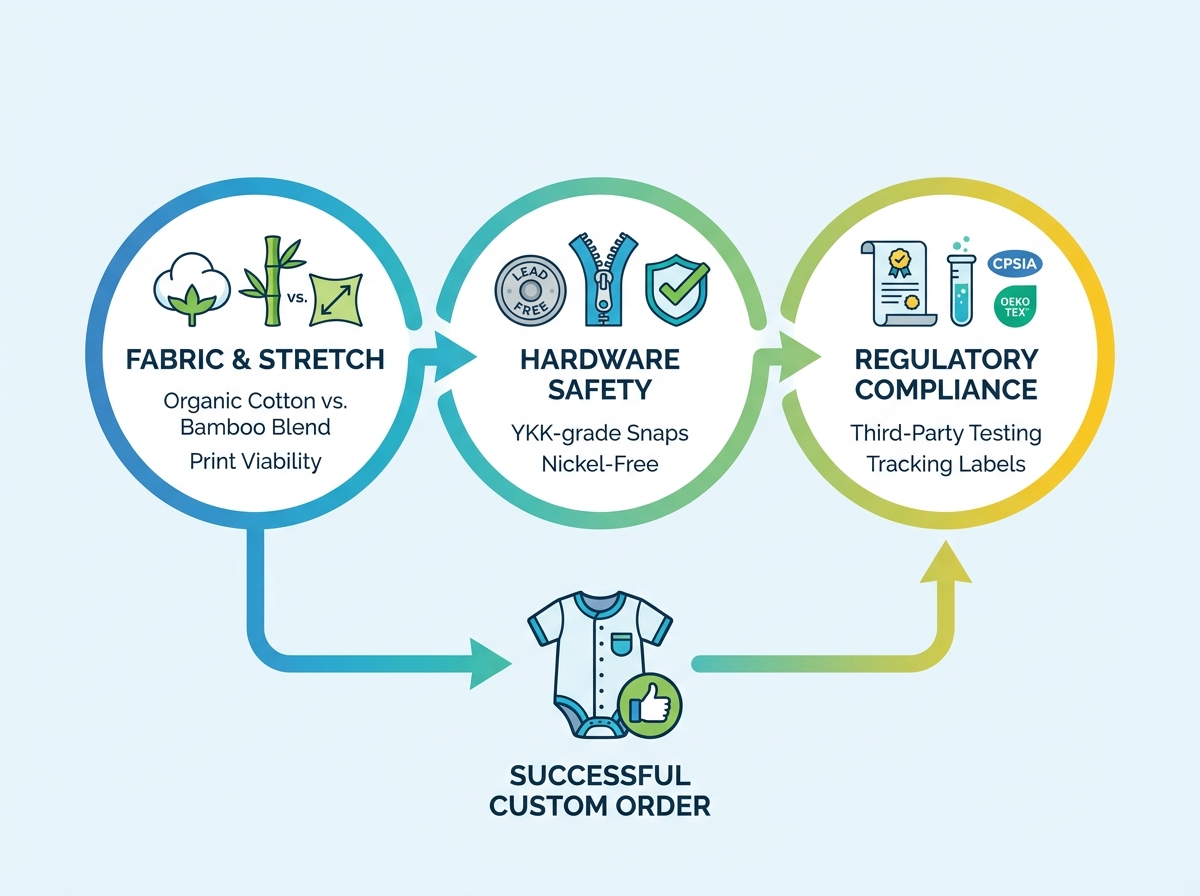
Fabric selection dictates the ultimate success of your infant apparel line. You must balance everyday durability against delicate skin safety. Parents wash infant clothes constantly, requiring highly resilient textiles.
Organic cotton offers exceptional high durability. It works wonderfully for standard screen printing applications. However, buyers must anticipate minor shrinkage after normal washing cycles. Sourcing GOTS-certified organic cotton adds significant premium market value.
Bamboo viscose blended into spandex represents the premium market standard today. It delivers unmatched softness and multidirectional stretch capabilities. You must maintain careful temperature control during custom printing on bamboo. High heat easily damages delicate viscose fibers during the ink curing phase.
Interlock and rib knit fabrics serve distinct functional purposes. Interlock provides a smoother, flatter surface for intricate custom designs. Conversely, rib knit offers superior horizontal stretch for easier, frustration-free dressing.
Fabric Category | Primary Benefit | Printing Recommendation | Implementation Risk |
|---|---|---|---|
100% Organic Cotton | High durability and structure | Standard water-based screen printing | Prone to minor post-wash shrinkage |
Bamboo Viscose Blend | Premium softness and high stretch | Low-heat curing methods | High heat damages delicate fibers |
Interlock Knit | Smooth, flat surface | Complex, highly detailed designs | Offers less horizontal stretch |
Rib Knit | Maximum dressing ease | Stretch-additive inks required | Inks easily crack upon stretching |
Heavy prints create severe implementation risks across all fabric categories. Requesting plastisol-based prints on lightweight bamboo blends creates stiff, rubbery patches. Parents quickly reject uncomfortable garments scratching their babies. A poorly chosen print method destroys the natural drape of premium textiles entirely.
Every closure must support rapid, stress-free diaper changes. Functional hardware defines the ultimate parent experience interacting daily.
Neckline construction directly affects daily dressing convenience. Envelope necklines allow garments to pull down over the body effortlessly. This specific structural feature proves vital during messy diaper blowouts. Pulling soiled garments downward avoids dragging messes across an infant's face. Shoulder snaps provide an excellent structural alternative, securing the neckline cleanly while offering wide head clearance.
Diaper-access hardware requires careful, methodical vetting protocols. You must choose between ring snaps, prong snaps, or two-way zippers. Always specify YKK-grade nickel-free brass snaps in your technical pack. Avoid inferior metals causing allergic reactions on delicate newborn skin.
Quality markers protect your brand reputation over the long term. Cheap plastic snaps often detach after repeated hot washing cycles. Detached snaps create severe, life-threatening choking hazards for infants.
Customer reviews frequently highlight poor accessibility as a major design flaw. Garments requiring a tight pull over the head demand sufficient fabric stretch. Lacking proper shoulder hardware, these restrictive items suffer terrible ratings. Busy parents prioritize ease of use far above aesthetic details.
Applying designs to an infant garment requires highly specialized techniques. Standard adult printing methods often fail miserably on tiny, stretchy clothes.
Water-based inks are completely mandatory for any infant wear project. They ensure a soft-hand feel across the entire Baby Romper. Traditional plastisol inks sit heavily on top of fabrics. These thick, rubbery layers irritate sensitive skin immediately.
Direct-to-Garment printing suits low-minimum, high-color designs beautifully. DTG requires a high-cotton composition to maintain acceptable wash-fastness. Pre-treatment fluids used in DTG must be hypoallergenic and fully washed out before final packaging.
Embroidery adds a premium aesthetic touch but poses high irritation risks. Heavy embroidery backing can easily scratch an infant during movement. You must explicitly specify soft, tear-away or mesh backing for stitched logos.
Implementation realities demand physical stretch testing during the sampling phase. A printed design may look perfect lying flat on a table. However, it often cracks aggressively when stretched over a squirming baby. Your manufacturing partner must use specialized stretch-additive inks to prevent this cracking disaster.
Custom infant apparel operates under heavy, strict regulation globally. Compliance protects both the vulnerable end consumer and your business entity.
The United States strictly enforces CPSIA compliance across all children's products. Mandatory tracking labels must exist on every single produced piece. You must integrate batch numbers, manufacturing dates, and specific locations into neck labels. Inner seam tags offer another legally acceptable placement location.
Lead and phthalate testing documentation is absolutely required by law. This critical rule applies to all applied paints, screen prints, and metal hardware. Reputable brands maintain a transparent database of these certificates.
Flammability standards heavily impact any garment classified as sleepwear. Sleepwear-specific items require exact snug-fit grading to pass federal regulations. Alternatively, they require heavy flame-retardant chemical treatments. The modern consumer market strongly prefers snug-fit organic options. Chemically treated garments face massive resistance from modern health-conscious parents.
Maintain a highly skeptical approach toward verbal factory claims. Never accept a factory's unverified promise regarding safety compliance. Always demand recent, third-party lab testing certificates for raw materials. Recognized institutions like SGS or Intertek provide reliable validation services.
Selecting the right manufacturing partner actively mitigates expensive production disasters. You must filter potential suppliers using distinct, measurable operational metrics.
Evaluate their minimum order quantities thoroughly before engaging further. Confirm their genuine willingness to produce accurate pre-production samples. Review their specific portfolio of infant wear carefully. Never use a generic promotional t-shirt printer for specialized infant clothing.
The sampling phase requires a strict, methodical two-step approach.
Order a blank, undecorated sample first to test base materials.
Test this blank rigorously for shrinkage and hardware durability.
Request a fully decorated pre-production sample next.
Verify precise print alignment and exact color accuracy before mass production.
Move forward systematically once you establish absolute vendor trust. Finalize your tech pack outlining every single required detail. Request comprehensive quotes outlining complete landed costs upfront. Ensure these financial quotes include all shipping and duty fees. Finally, commission your very first sample to begin the manufacturing journey.
A successful custom apparel order requires deliberate, careful planning. You must constantly balance aesthetic vision against strict functional reality. Beautiful designs mean absolutely nothing if the garment fails basic safety tests. Prioritizing parent utility ensures long-term customer loyalty and repeat purchases. Easy diaper changes and durable washability matter immensely to your target audience.
Strict safety compliance protects your brand reputation entirely. It also secures your business against devastating, costly product recalls. Take immediate, decisive action to formalize your production requirements today. Finalize your tech pack documenting precise material blends and hardware specifications. Submit these finalized details before requesting your first pre-production sample.
A: Standard MOQs vary significantly based on your manufacturing approach. Blank customization, where you print on pre-made garments, offers low MOQs. You can often order as few as 50 units. Cut-and-sew manufacturing requires building the garment from scratch. This custom approach typically demands a high MOQ, often exceeding 500 units per colorway.
A: You must explicitly request water-based, non-toxic inks from your manufacturer. Avoid traditional plastisol inks containing harsh chemicals. Additionally, require your factory to provide Oeko-Tex Standard 100 certification. This globally recognized certification guarantees the final print contains no harmful substances.
A: A Baby Romper functions as a complete outer outfit. It typically features attached shorts or pants and sleeves. A onesie, or bodysuit, lacks legs entirely. Parents generally use onesies as base layers or undergarments. Defining this distinction helps buyers specify the correct base silhouette.
A: Tracking labels represent a strict legal requirement under consumer product safety laws. They provide essential traceability during product recalls. The label must display the manufacturing location, date, and batch number. Failing to include this tracking information can trigger severe regulatory fines.


