
close
Choose Your Site
Global
Social Media
Views: 0 Author: Site Editor Publish Time: 2026-07-16 Origin: Site


Entering the infant apparel market presents distinct commercial and regulatory hurdles. Founders often underestimate the strict safety standards governing clothes for babies and toddlers. You face heavy testing requirements while trying to manage incredibly tight profit margins. This guide serves as a practical roadmap. We designed it specifically for founders and procurement teams moving from a rough sketch to full-scale production. You will learn how to build a highly profitable Baby Romper line safely and effectively. We cover the complete manufacturing process step by step. Our main goal is straightforward. We want to help you balance sustainable unit economics alongside non-negotiable safety compliance and highly functional design. By following these proven industry principles, you can confidently bring your brand to life. You will avoid the costly early mistakes trapping many new apparel entrepreneurs.
Success in the 0-24M category requires strict adherence to sizing allowances (diaper space) and hardware safety (pull-testing).
Material selection directly dictates your compliance pathway (e.g., CPSIA, OEKO-TEX®, GOTS).
Choosing between white label, private label, and OEM depends entirely on your initial budget, required time-to-market, and Minimum Order Quantity (MOQ) tolerance.
Profitable margins rely on accurate landed-cost modeling, including third-party lab testing and packaging volumetric weight.
We must separate cute ideas from practical reality. Functional design heavily outweighs aesthetic appeal in infant apparel. Pattern grading needs precise diaper accommodation. Disposable diapers carry specific dimensions. Reusable cloth diapers add much more bulk. You must scale seat measurements properly. If you ignore this extra bulk, the garment rides up the leg uncomfortably.
Neckline variations solve daily parenting struggles. Envelope necks provide massive utility. Parents can easily pull the garment down over the shoulders. This clever design prevents pulling messy clothes over a baby's head after a diaper blowout. Alternatively, standard crew necks look cleaner. They require shoulder snaps to widen the head opening safely.
Every closure mechanism carries both risk and utility. Two-way zippers dominate the modern market. They allow fast diaper access from the bottom up. However, zippers present serious skin pinching hazards. You must design interior backing guards. These internal fabric strips sit directly behind the zipper teeth. They protect delicate skin during midnight outfit changes. Nickel-free snaps offer another popular route. Metal snaps tear knit fabric easily under pressure. You must add reinforced woven twill tape directly behind the snap panels. Without reinforcement, impatient parents will rip the fabric entirely.
Implementation risk runs high for beginners. Factories interpret vague instructions poorly. You must standardize your tech packs. Include exact millimeter placements for every piece of hardware. Bad tech packs guarantee high defect rates in your first production run.
Material choices control your production timeline. They also dictate your legal compliance pathways.
Assess fabric composition carefully. Many brands launch utilizing 100% organic cotton. It breathes exceptionally well. It naturally limits skin irritation. Other brands utilize bamboo blends. Bamboo provides incredible softness. It stretches easily. Evaluate your spandex ratio closely. A 5% spandex addition drastically improves shape recovery. Garments will not stretch out loosely during daily wear. Measure fabric weight via GSM (grams per square meter). Summer collections require 160 to 180 GSM. Winter pieces need heavier 220 to 250 GSM. Always enforce strict shrinkage tolerances. Infant wear experiences frequent hot water washing. Demand pre-shrunk fabric treatments before cutting begins.
Regulatory certifications define your legal boundaries. North America relies heavily on CPSIA rules. Europe enforces strict REACH standards. Both governing bodies mandate third-party lab testing. You must test dyes, fabrics, and hardware for lead and phthalates. We strongly suggest acquiring OEKO-TEX® Standard 100 Class 1 certification. Class 1 specifically targets items touching infant skin directly. It proves your materials lack harmful chemical residues. If you market goods as organic, you need GOTS Certification. GOTS verifies your entire supply chain. It traces raw materials from the farm directly to the factory floor.
Flammability standards present a unique challenge. The CPSC aggressively regulates infant sleepwear flammability. You want to avoid chemical flame retardants completely. Chemical treatments anger modern parents. Navigate this hurdle by using "tight-fitting" exemptions. Follow the strict CPSC sizing charts precisely. Snug garments leave no air gaps. This lack of oxygen prevents rapid fire spread naturally.
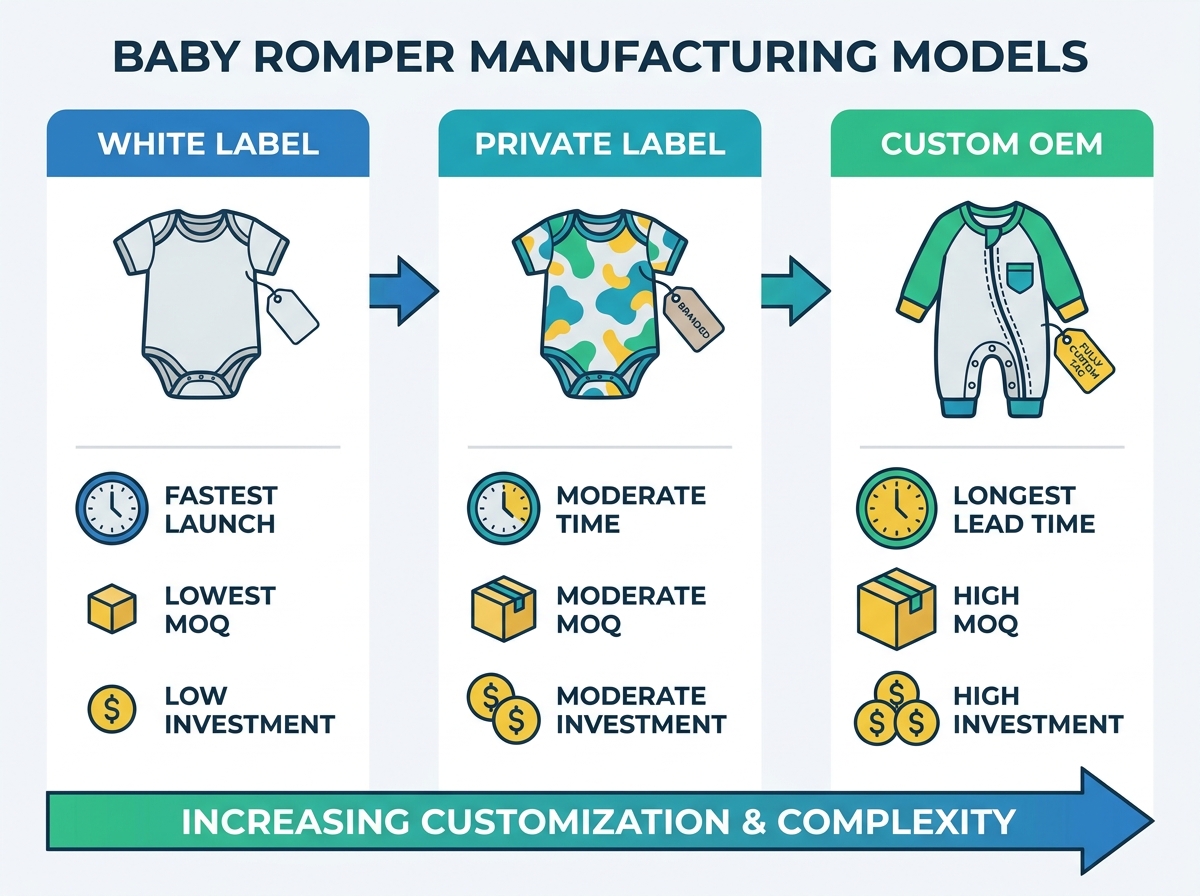
Manufacturing models determine your financial commitment. Let us compare white label, private label, and custom OEM approaches.
White label wholesale offers the lowest barrier to entry. You buy pre-manufactured blank garments. The factory ships them immediately. You face tiny minimum order quantities. However, you gain zero structural differentiation. The silhouette looks identical to hundreds of competing brands. This model fits print-on-demand sellers perfectly.
Private label sits in the middle. You customize existing factory patterns. Factories already know how to sew these pieces efficiently. MOQs remain moderate. You can request custom fabric prints. You easily apply custom branding. We highly recommend heat transfer tags. Woven neck tags scratch sensitive skin. Heat transfers melt directly into the fabric. You leverage proven factory silhouettes while steadily building brand equity.
Custom OEM involves cutting and sewing from scratch. You dream up a completely new design. MOQs jump significantly here. Expect factory demands of 500 to 1,000 units per style and color. Factories enforce these limits because dye houses require minimum fabric yardage runs. You must supply intensely detailed tech packs. In exchange, you own a fully proprietary design. Nobody else can sell your exact fit.
Manufacturing Model | Typical MOQ | Time-to-Market | Design Flexibility |
|---|---|---|---|
White Label | 0 - 50 units | Immediate | None (Tags only) |
Private Label | 100 - 300 units | 4 - 8 weeks | Moderate (Prints/Colors) |
Custom OEM | 500+ units | 3 - 6 months | High (Fully Custom) |
Align your capital constraints with the right tier carefully. Do not stretch your budget on OEM if you merely want to test a fun pattern.
Supplier evaluation secures your brand reputation. Treat factories like long-term business partners.
Assess their specific capabilities first. Do they specialize exclusively in 0-24M knitwear? General apparel factories handle adult t-shirts well. They usually fail at baby apparel. Specialization matters immensely for grading baby sizes. A quarter-inch mistake ruins a newborn fit completely. Ask for photos of their cutting and sewing lines.
Establish robust Quality Control standards immediately. Adult clothing usually accepts an AQL of 2.5. Baby wear requires a much stricter AQL of 1.5. This means fewer defects are allowed per production batch. You must enforce mandatory in-line testing. Do not wait until production ends. Specify snap pull-tests directly in your factory contract. Machines must pull snaps using a minimum of 90 Newtons of force. Snaps breaking off become fatal choking hazards. Furthermore, require a needle-detection machine pass. Broken sewing needles often hide inside finished seams. Every single garment must pass through a magnetic scanner before final polybagging.
Audits verify safe working conditions. Ethical labor acts as a massive consumer trust factor. Millennial and Gen Z parents care deeply about ethical supply chains. Demand current audit reports from suppliers. Look for BSCI, WRAP, or Sedex certifications. These independent documents prove the factory pays fair wages. They verify the building has proper fire exits and ventilation.
Unit economics determine your absolute survival. You must model your margins obsessively.
Understand complex MOQ structures clearly. Factories quote minimums in different ways. Some require an MOQ per fabric color. Others demand an MOQ per exact size. Negotiate split sizing early. You might commit to 800 units of custom-dyed green fabric. Ask the factory to split those 800 units across four different sizes. This strategy builds a cohesive product collection. It stops you from over-leveraging vital cash into a single SKU.
Map out your true landed cost breakdown. The factory per-unit quote only tells part of the story. Add your raw material consumption. Include Cut, Make, and Trim (CMT) labor costs. Factor in specific hardware surcharges. Custom-dyed YKK zippers cost significantly more than generic black ones. Branded snaps add cents to every individual piece. Do not forget hidden fees. Third-party lab testing costs hundreds of dollars per colorway. Shipping pre-production samples back and forth via air freight adds up quickly. Volumetric weight for packaging also inflates final ocean freight bills.
Develop a realistic pricing strategy. The infant apparel vertical suffers from notoriously high customer acquisition costs. Marketing on social media drains budgets fast. You must calculate strong markup targets. Aim for 3x to 5x your landed cost. If your Baby Romper lands in your warehouse for $7, retail it between $21 and $35. This gross margin effectively absorbs your marketing costs. It provides comfortable padding for seasonal discounts and wholesale channel pricing.
Next steps transition your brand into reality. Sequence your rollout carefully.
Finalize the tech pack completely. Lock down your full Bill of Materials. Detail every thread type and snap size. Ensure your graded measurements cover every size from newborn up to 24 months accurately. Clarify construction details like seam allowances and stitch types. Flatlock seams prevent chafing, but they cost slightly more to sew.
The sampling phase demands intense patience. Never skip these critical milestones:
Fit Sample: Factories make this using generic scrap fabric. Use it strictly to verify sizing. Put it on a live baby or a standardized mannequin. Check the diaper clearance and armhole drops carefully.
PP Sample (Pre-Production): The factory uses your actual dyed fabric and custom hardware. You must scrutinize this piece closely. Give your final sign-off only when it looks absolutely perfect. Bulk production replicates this exact sample.
TOP Sample (Top of Production): The factory pulls this from the very first completed bulk run. Use it immediately for lifestyle photoshoots and early marketing campaigns.
Drafting the Purchase Order requires strategic leverage. Tie your payment terms directly to quality inspection pass rates. A 30/70 split represents a safe industry standard. Pay 30% upfront so the factory can purchase raw materials. Keep the remaining 70% secured. Release the final funds only after a third-party QC inspector passes the goods on the factory floor.
Launching a reputable baby wear brand requires immense discipline. Successful development hinges on front-loading your mandatory compliance checks. Never treat safety testing as a secondary afterthought. It dictates your material choices from day one. Choosing a highly specialized manufacturing partner drastically lowers your failure rate. They already understand the micro-grading and safety protocols you need.
Take direct action immediately. Finalize your tech packs now. Ensure your hardware placements are mathematically precise. Reach out to multiple vetted factories to request detailed capability profiles. Order fabric swatches to test their stretch and shrinkage firsthand. Finally, model your landed costs down to the penny. By moving methodically, you will build a safe, highly profitable apparel line.
A: Private label manufacturers typically require an MOQ of 100 to 300 units per style or color. This allows you to customize existing silhouettes with your own prints and branding without the steep financial commitments of full custom OEM production.
A: Developing a custom OEM garment usually takes 3 to 6 months. This timeline includes intricate pattern making, tech pack creation, multiple sampling rounds, fabric dyeing, bulk production, and third-party safety testing before final shipment.
A: Yes. CPSIA regulations strictly require you to test every distinct colorway and material. Lead and phthalates often hide secretly in specific dye pigments. A test pass on a blue fabric does not legally clear the red fabric in the exact same collection.
A: 100% organic cotton and bamboo blends are the top choices. Organic cotton breathes highly and lacks harsh agricultural chemicals. Bamboo offers superior softness, excellent moisture-wicking properties, and natural temperature regulation for extremely delicate skin.
A: A pattern acts as the physical or digital template used to cut the fabric shapes. A tech pack acts as the instruction manual. It contains the complete Bill of Materials, sizing grades, hardware placements, and sewing instructions required to assemble those cut pieces accurately.


